

The Black/African American Healthcare Experience: Understanding Maternal Health Through History and Lived Reality – Part I
Filed Under: Black / African American, Multicultural, Healthcare

Angela Roberts
Vice President, Administration & Project Support

As our CultureBeat team continues to highlight healthcare and wellness during this year’s celebration of a century of Black/African American History Month, we turn our focus to the maternal healthcare journey. With heartfelt caution, we invite the reader into a profoundly sensitive and disturbing experience. . .
Picture yourself—or someone you love—receiving the joyful news that a new life is on the way. Family and friends gather a few months later for a vibrant gender reveal celebration; the parents-to-be are showered with love and gifts for the baby. Everyone is excited and counting the days until they will finally meet the newest addition to the family.
Fast-forward on this journey to the hospital waiting room, where we find the soon-to-be grandparents taking turns pacing between sips of coffee as they eagerly await their grandchild’s arrival. Their cell phones are in-hand so that they can constantly share updates with the family. Hours pass as the room hums with anticipation and hope. But then, in an instant, the air shifts.
There’s a complication! An earlier warning sign that was brushed aside is now suddenly urgent!
Fear rushes in where joy once lived! Yet, there’s hope that the situation resolves—but instead. . .
It spirals…and the moment no family should ever face—a mother, baby, or both are suddenly in life-threatening danger. And the devastated family wonders. . .
“HOW did we get here?
And, WHY are we here in this age of advanced, modern medicine?”
Scenes like this are not rare or exaggerated. They reflect a painful truth for many Black/African American families. To understand how we arrive at such moments, we must look beyond the delivery room and examine the broader forces shaping maternal health outcomes.
Despite significant advances in modern medicine, racial disparities in health outcomes remain a documented and ongoing challenge for the Black/African American community. These disparities stem from the cumulative impact of structural conditions, including historical inequities, uneven access to care, and bias within clinical environments. Over time, these factors have influenced not only health outcomes, but also how Black/African American patients engage with the healthcare system, shaping expectations, preferences, and levels of trust.
For Black/African American women, in particular, these intersecting dynamics are especially pronounced within maternal healthcare. Along with higher rates of chronic illnesses, Black/African American women also continue to experience higher rates of maternal mortality, as shared in detail in the Black/African American Maternal Mental Health Issue Brief published by the Policy Center for Maternal Mental Health. These realities shape how Black/African American women prepare for pregnancy, select providers, and assess their own safety throughout the process.
The Alarming Reality Facing Black/African American Mothers
The crisis in maternal health outcomes for Black/American women warrants urgent attention. In 2023, the CDC reported the maternal mortality rate for Black/African American women at 50.3 deaths per 100,000 live births, significantly higher than rates for their non-Hispanic White (14.5), Hispanic (12.4), or Asian (10.7) counterparts. Even more alarming, the CDC estimates that more than 80% of all pregnancy-related deaths in the U.S. are considered preventable. And, while many deaths happen in the hospital during delivery, well over half of all pregnancy-related deaths occur during postpartum, a period marked by both emotional and physical vulnerability for women.
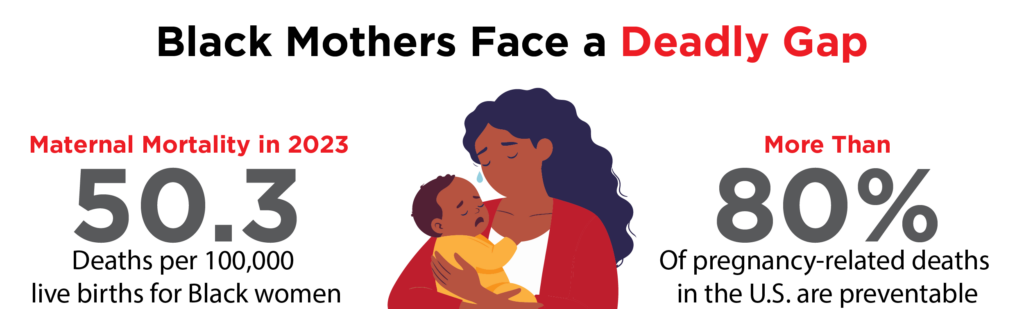
With the highest postpartum mortality rates affecting Black/African American women, these disparities paint a troubling picture and fuel concerns about the safety and trustworthiness for expecting mothers. The impact of these concerns traverse the entire healthcare ecosystem, signaling the need for collaboration and accountability across multiple disciplines—from insurance and access, to quality of care, to follow-up and postpartum support.
The numbers, however, tell only part of the story—the lived experiences of Black/African American mothers reveal the emotional weight behind these disparities.
The Emotional Reality of Childbirth for Black/African American Mothers
For expecting Black/African American mothers who are evaluating where to give birth, their questions often extend beyond standard hospital considerations. They may turn to other Black/African American women or their physician and ask:
“Will I be treated with respect?”
“Will I be pressured into a C-section or into taking medicine I don’t want to take?”
And in moments of deep vulnerability, some even ask directly: “Am I going to die?”
When the delivery room feels like a question of survival.
Faith, age 34, mother of 2
History’s Lingering Influence on Black/African American Women Navigating the Healthcare System
The troubling concerns about what their healthcare experiences might consist of are not the result of anecdotal misunderstandings; they are responses to systemic realities. And, it’s not current statistics alone that cause concern. The history of healthcare in the U.S. for the Black/African American community is one that has cultivated a deep-rooted mistrust of the system as a whole:
History isn’t abstract—it shapes today’s trust.
Jennifer Doucet, DSW, LCSW, IL, LCSW-LA, MSW
Most members of the Black/African American community have general awareness of the painful history of mistreatment in healthcare even when the specific details are not always fully, or even accurately articulated. The stories that have been shared across generations contribute to the deeply rooted fear and caution that exists today. This inherited mistrust contributes to hesitancy toward the healthcare system and can directly impact participation in medical research, as potential participants may choose not to engage. Equally important, it can also shape how Black/African American mothers select their caregiving and medical support teams.
Informed by history, many decline research—not from ignorance, but experience.
Nicole, age 33, mother of 4 and expecting
Hearing these stories directly from Black/African American women reminds us that the weight these mothers carry into pregnancy is not imagined; it is inherited, reinforced, and deeply personal. The fear voiced in these stories is shaped by history, but also by what too many families still witness today. When history and current experiences collide, they create a maternal journey marked by both hope and caution—a balance no family should have to navigate alone.
Why It Matters
- The fear, the vigilance, the questions about safety that we see in maternal healthcare today are the echoes of a past that is still very present in the lives of Black/African American women and their families.
- When organizations and brands understand this history, they gain a clearer view of why trust is fragile and why statistics alone cannot tell the full story.
- The experiences shared across generations explain why Black/African American mothers approach pregnancy with both hope and caution, why many decline participating in medical research, and why the stakes feel so high from the very beginning.
- Acknowledging how we arrived here helps to clearly show what must be rebuilt.
In Part II of this article, we will explore how these historical realities interact with modern stressors, clinical environments, and the urgent need for culturally aligned, respectful, and patient-centered maternal care. Stay tuned.