The LGBTQ+ Health & Wellness Experience Series
Pride and LGBTQ+ Mental Health: How Brands Can Show Up with Purpose
Filed Under: Market Research, LGBTQ+, Healthcare, Immersive Online Discussions

Anna Rossi
Senior Director, Quantitative Research
Happy Pride!
C+R’s CultureBeat team is excited to continue our exploration of health & wellness within the LGBTQ+ community with you. Today, let’s delve into mental health!
The Mental Health Picture

Mental health has traditionally been highly stigmatized, and while much stigma still exists, openly discussing and caring for one’s mental health has become more accepted in today’s society, especially with younger generations. Despite these gains, however, progress in awareness and access to care remains uneven.
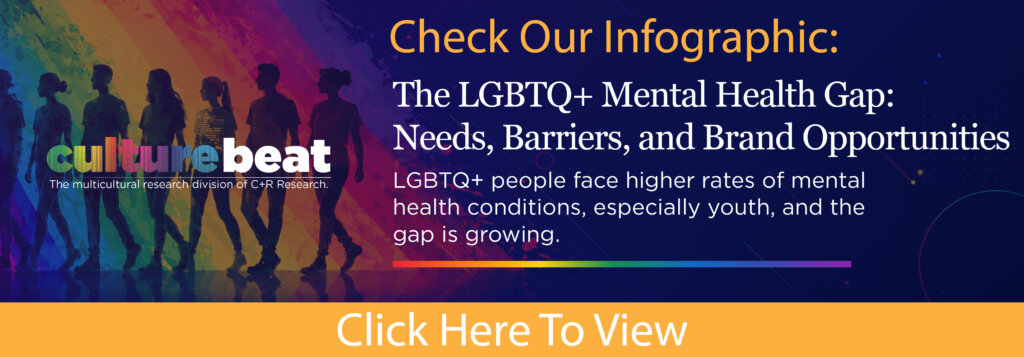
These disparities are particularly evident within the LGBTQ+ community, where mental health needs are disproportionately high and access to care often falls short. LGBTQ+ people are more likely to experience mental health conditions, including anxiety, depression, PTSD, bipolar disorder, and eating disorders. These conditions are especially likely to impact LGBTQ+ youth, who often have more limited access to care even when they want it. Unfortunately, the mental health crisis for LGBTQ+ people is getting worse, and the progress the industry has made so far hasn’t done enough to positively impact the LGBTQ+ community.
What’s Driving the Crisis

While LGBTQ+ people are more likely to experience mental health conditions, that doesn’t mean being LGBTQ+ inherently leads to poor mental health. In other words, this crisis is not driven by their identity, rather it’s driven by outside factors that impact the lived experiences of this community. There are three interconnected forces that shape the mental health crisis among the LGBTQ+ community.
- Discrimination & hostile environments.
In our previous blog, we reviewed how LGBTQ+ people were more likely to experience discrimination within healthcare. The community experiences discrimination beyond just in the healthcare space, though. Discrimination in workplaces, housing, and public spaces such as stores and restaurants compounds over time, contributing to higher rates of mental health conditions within the community. For youth, bullying is especially harmful, with more than half of LGBTQ+ middle and high schoolers reporting being bullied in the past year, which is linked to higher rates of severe depression and suicide attempts.
- Anti-LGBTQ+ political rhetoric.
Second, political discourse doesn’t happen in a vacuum. LGBTQ+ people, especially transgender and non-binary folks, have been at the forefront of political rhetoric for the past several years. This impacts mental health in several ways. First, federal and state-level laws and policies shape lived experiences; as protections and rights get stripped away and are replaced with restrictions, it limits people’s access to needed care. Even if rights are upheld or progress is made, the negative rhetoric is everywhere. Imagine listening helplessly to a room full of people speaking poorly of you, lying about you, and trying to take away your freedoms. That’s a measurable clinical stressor that contributes to poor mental health outcomes. Finally, the political discourse has made it acceptable for similar public debate, leading to higher rates of discrimination and more hostile environments for people in their everyday lives.
- Family rejection.
Unfortunately, home isn’t always a safe space for LGBTQ+ people, especially youth, as they experience rejection from their family. This can be in terms of how they are treated, being kicked out of the house, or having to hide their true selves. Youth with unsupportive families are more likely to experience anxiety and are more likely to consider suicide. Conversely, having even one affirming adult in their life significantly reduces risk.
CultureBeat’s POV
The LGBTQ+ community is in a mental health crisis, and support is unlikely to come from the government. That creates both a responsibility and an opportunity for brands to help. Health insurers and managed care organizations that offer mental health services should recognize the community’s urgent need and work to expand access to affirming care. Pharmaceutical and clinical brands should include LGBTQ+ people in their clinical trials and find ways to help ensure their messaging & products resonate with this audience.
And because access to mental health care remains limited for some LGBTQ+ people, brands in fitness, wellness, health, and personal care can also play a meaningful role in closing gaps. However, since access to mental health care can be limited for some members of the community, there is also space for other brands to help close gaps, especially those in the fitness, wellness, health, and personal care spaces.
Brands need to listen, co-create, and involve LGBTQ+ voices at every stage to build products, platforms, and messaging that truly resonate. That means reflecting LGBTQ+ lived realities in messaging, making affordability and easy access central to the value proposition, investing in community-based organizations, and measuring impact over time.
The wellness brands that earn the LGBTQ+’s community’s trust, especially among youth, will be those that understand their lived realities and work alongside to support long-term solutions for mental health wellness.
“Brands need to listen, co-create, and involve LGBTQ+ voices at every stage to build products, platforms, and messaging that truly resonate.”
Want to Learn More?
C+R’s CultureBeat team recognizes that one of the most meaningful ways brands can show up consistently is by supporting the health and well-being of the LGBTQ+ community, an area where thoughtful action can make a real difference. So, this year, we are spotlighting health & wellness for the LGBTQ+ community: the real issues they face, the moments of joy, and how your brand can make an impact that extends far beyond Pride Month. Stay tuned for more on the LGBTQ+ community and health & wellness throughout June and October.